
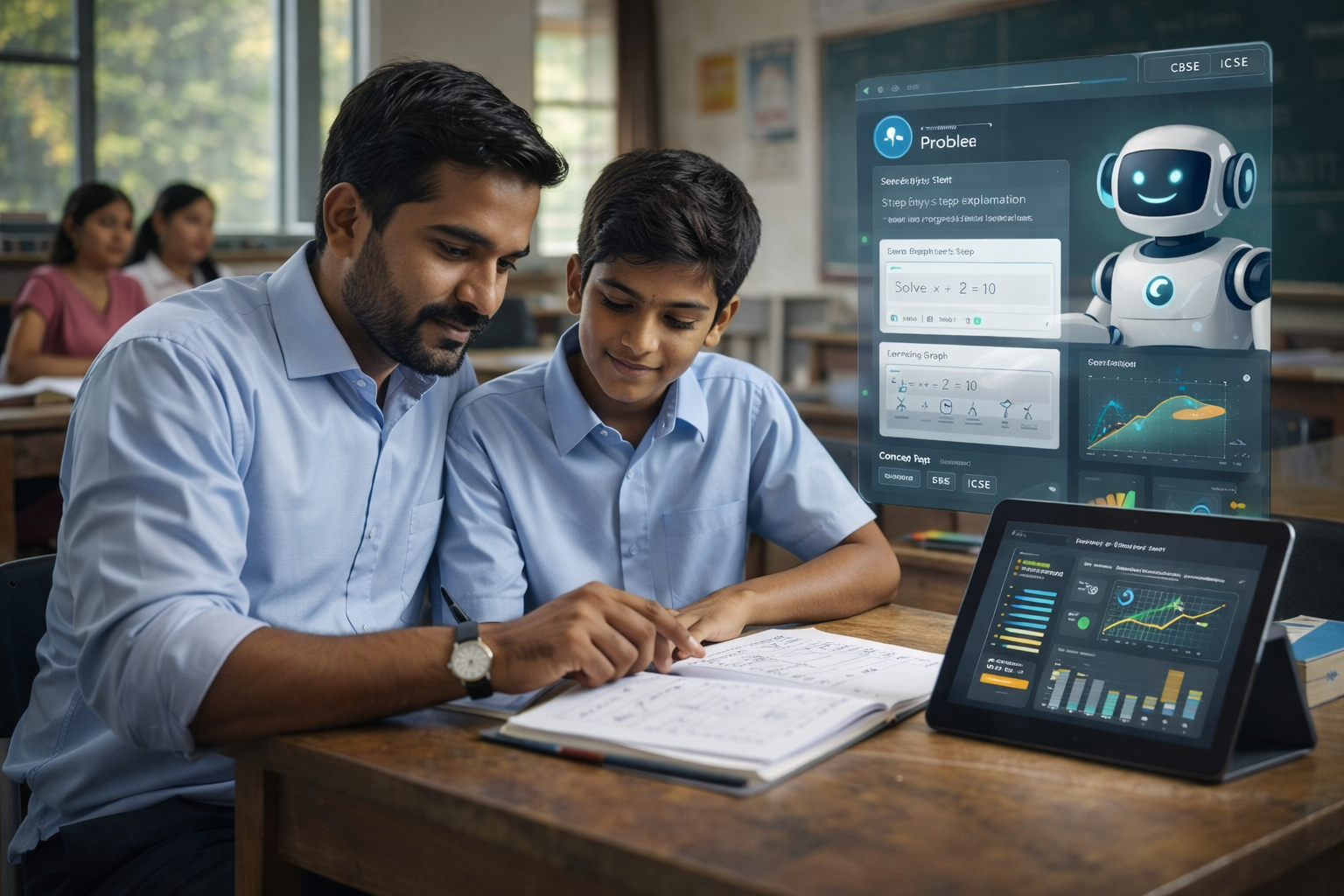
Every child bursts with untapped potential for learning and growth. Yet, no two kids learn at the same pace or through identical methods. In a bustling classroom, it's impossible for every topic to click for every student. Some concepts linger as foggy doubts, and teachers—despite their expertise—can't be everywhere at once to clear them up. This is where AI in education steps in as a game-changer, acting as a personalized learning assistant that supports teachers, minimizes overload, and unlocks flexible learning paths.
Imagine a student in Class 10 struggling with quadratic equations under the CBSE board. The teacher moves on, but the doubt festers. Enter AI: available 24/7, tailoring explanations to the student's class, subject, and curriculum. It's not about replacing human educators; it's about bridging learning gaps with precision and empathy.
The Challenges of Traditional Classroom Learning
Classrooms are dynamic hubs of knowledge, but they're not perfect. Teachers juggle 30–40 students, diverse learning styles, and packed syllabi. According to a 2024 UNESCO report, over 60% of students worldwide face unmet learning needs due to these constraints. Key pain points include:
These gaps hinder potential. Students disengage, grades slip, and confidence erodes. But what if technology could personalize the experience without overwhelming teachers?
AI in education isn't a distant dream; it's here, powered by advanced models like natural language processing and machine learning. AI acts as a personalized mentor, analyzing a student's queries, class level, and subject to deliver spot-on solutions.
Unlike rigid textbooks, AI adapts dynamically. Ask about Pythagoras' theorem? It explains via visuals, step-by-step breakdowns, or even quizzes. Stuck on a biology diagram? It generates custom mnemonics tied to your board's syllabus. This flexible learning path ensures 24/7 access, with no waiting for office hours.
Crucially, AI supports teachers, not supplants them. By handling routine doubts, it frees educators for deeper discussions, creative projects, and emotional guidance. Teacher workload drops, burnout decreases, and classroom efficiency soars.

Why is bridging learning gaps with AI so transformative? Let's break it down:
AI customizes content based on your pace. Slow on calculus? It simplifies with analogies, like comparing derivatives to speedometers. Advanced? It challenges with Olympiad-level problems. A 2025 EdTech study found students using AI tutors improved scores by 35% in STEM subjects.
Doubts don't clock out at 3 PM. AI provides round-the-clock help in multiple languages, including Hindi, Marathi, or regional dialects—perfect for diverse Indian boards like CBSE, ICSE, or state curricula.
Every lesson matters, but tough spots like integration in math or stoichiometry in chemistry need extra love. AI identifies these via query patterns and offers targeted drills, videos, and practice sets.
AI dashboards track progress, flagging struggling students for teachers. This creates a symbiotic loop: AI handles basics, and humans nurture holistic growth.
From rural Maharashtra schools to urban coaching centers, AI democratizes quality education. Apps like Khan Academy AI or custom bots make elite tutoring free or affordable.
Real-world example: In Pune's competitive exam scene, students prepping for JEE use AI for personalized mock tests. One user shared, "AI caught my weak integrals early—my rank jumped 500 spots!"
India's edtech boom showcases AI's impact. Byju's AI features adaptive learning for 150 million users, while Doubtnut's scanner resolves photo-based queries in seconds. A 2025 NEP-aligned pilot in Maharashtra schools saw 40% doubt resolution via AI chatbots, boosting attendance and parental satisfaction.
Globally, Duolingo's AI gamifies languages, retaining 70% more users. These stories prove AI tutors for students aren't hype; they deliver measurable results.
As we head into 2026, personalized learning with AI will integrate VR simulations, emotional AI for motivation, and predictive analytics for career guidance. India's National Education Policy 2020 emphasizes tech-driven equity; AI is the bridge.
Teachers remain irreplaceable for inspiration and ethics. AI handles the "how"; they provide the "why." Together, they minimize overload and maximize potential.
AI in education is reshaping how we learn, one doubt at a time. Whether you're a parent seeking to bridge learning gaps with AI or a student needing that extra push, tools like Perplexity AI or edtech platforms are ready.

February 02, 2026